

📝 Disclaimer: The content on this site is for informational and educational purposes only and does not constitute professional advice. Always consult with a qualified veterinarian or professional for your pet's specific needs.
* This post may contain affiliate links. As an Amazon Associate, we earn from qualifying purchases at no extra cost to you.
* This site uses AI technology for content assistance and illustrative imagery. Images are for demonstration purposes and do not depict real people or events.
What Maternal Behavior Means in Cats
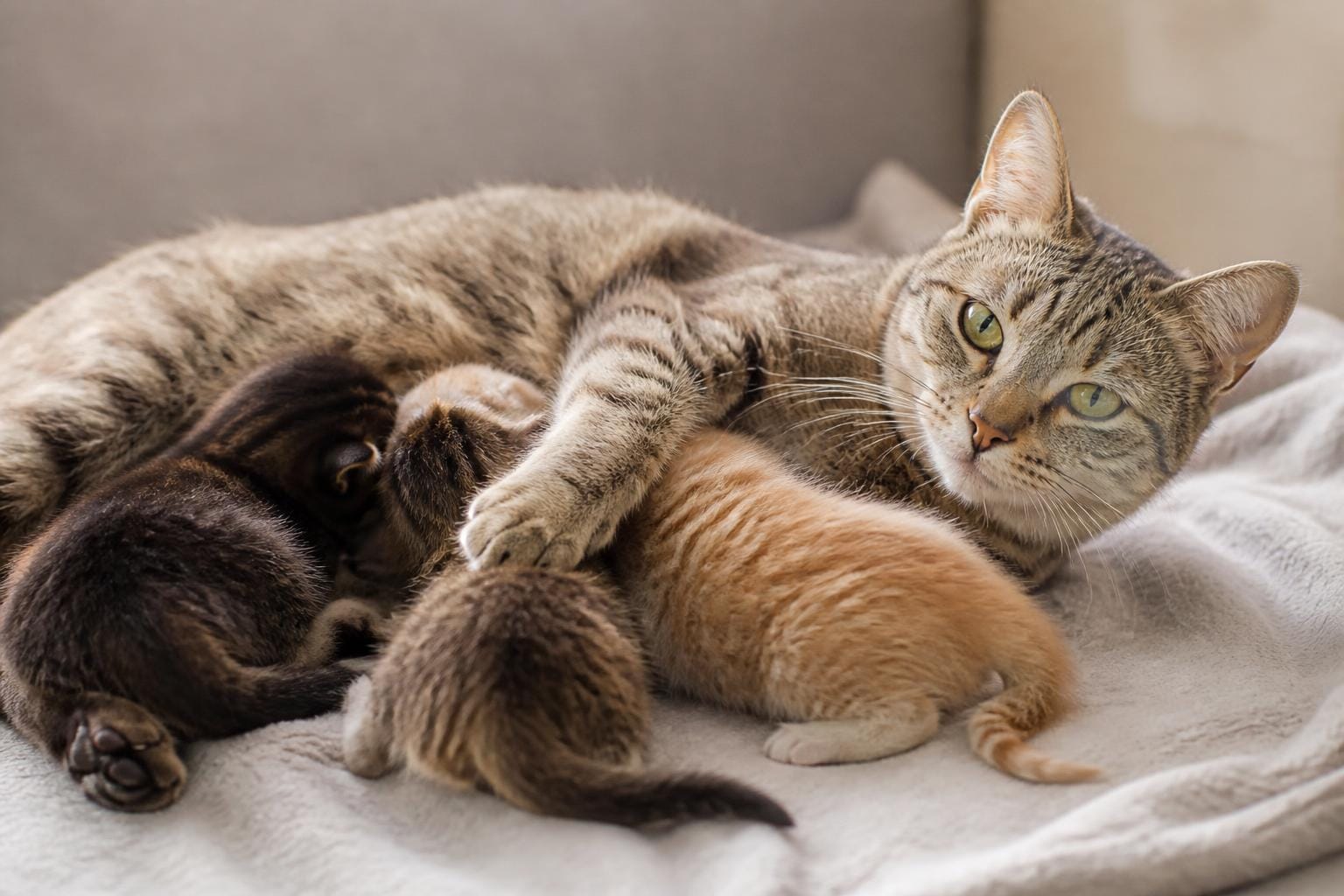
Cat maternal behavior refers to the natural patterns associated with pregnancy, birth, and care of dependent young. These patterns can include nest-seeking, grooming, nursing, retrieving, protection, and responses to kitten vocalizations. The term describes a broad behavioral system rather than a single action or fixed emotional state.
Such behavior is most visible in queens, the term commonly used for female cats, during the period when kittens rely heavily on maternal contact. Its expression can differ among individuals and may also be influenced by previous experience, social surroundings, and the developmental stage of the kittens.
Biological Foundations of Maternal Care
Maternal behavior is linked to changes in the body and nervous system surrounding birth. Hormonal shifts associated with pregnancy and parturition can affect attention toward newborns, milk production, grooming, and responses to movement or vocal sounds. Sensory cues from the kittens may reinforce these responses through continued contact.
Grooming has several biological roles in early life. It provides tactile stimulation and helps maintain close contact between the mother and kittens. Nursing supplies nourishment while also creating repeated physical interaction. These activities are coordinated with periods of rest, movement, and environmental awareness.
The phrase “maternal instinct” is often used in everyday language, but behavioral science generally treats maternal care as a combination of inherited predispositions, physiological changes, learning, and immediate circumstances. This wording allows for variation rather than assuming that every female cat will behave in exactly the same way.
Common Natural Patterns
Maternal responses often change as kittens mature. Newborns require close contact and frequent nursing, while older kittens gradually become more mobile and begin exploring their surroundings. Maternal involvement may therefore shift from constant physical care toward intermittent nursing, social contact, and boundary-setting.
Some queens move kittens between locations, particularly when environmental conditions change. This behavior is commonly interpreted as a nest-management pattern, though the specific reasons may vary. Vocal exchanges can also occur between a mother and her kittens, helping maintain contact when they are not directly touching.
Care patterns are not identical across cats. Some mothers remain highly attentive, while others show shorter or less visible periods of contact. Lack of a single behavior does not, by itself, establish a conclusion about motivation, attachment, or welfare.
Natural Pattern Observations
- Grooming: Licking is a prominent form of contact between a mother and very young kittens.
- Nursing: Milk feeding is concentrated during the early developmental period and changes as kittens become more independent.
- Retrieval: Some mothers carry kittens by the loose skin around the neck, a behavior associated with relocation.
- Vocal communication: Calls from kittens can draw maternal attention, although responses vary among individuals.
- Nest behavior: Quiet, sheltered locations are often associated with birth and early kitten care in free-ranging cats.
Maternal Behavior in Ecological Context
Domestic cats retain behavioral features that are also observed in wild felids, although domestic environments can alter how those features appear. In free-ranging populations, maternal behavior occurs within an ecological setting that includes food availability, shelter, human activity, weather, and interactions with other cats.
Social conditions can vary widely. Some females may share space or show overlapping care patterns, while others remain more solitary. Related females may form loose social associations, but the existence and strength of these relationships differ between groups.
Research discussions commonly describe feline maternal care as flexible rather than governed by one universal sequence. Studying these patterns helps clarify how inherited behavior, physiology, learning, and environment interact in a familiar mammalian species.